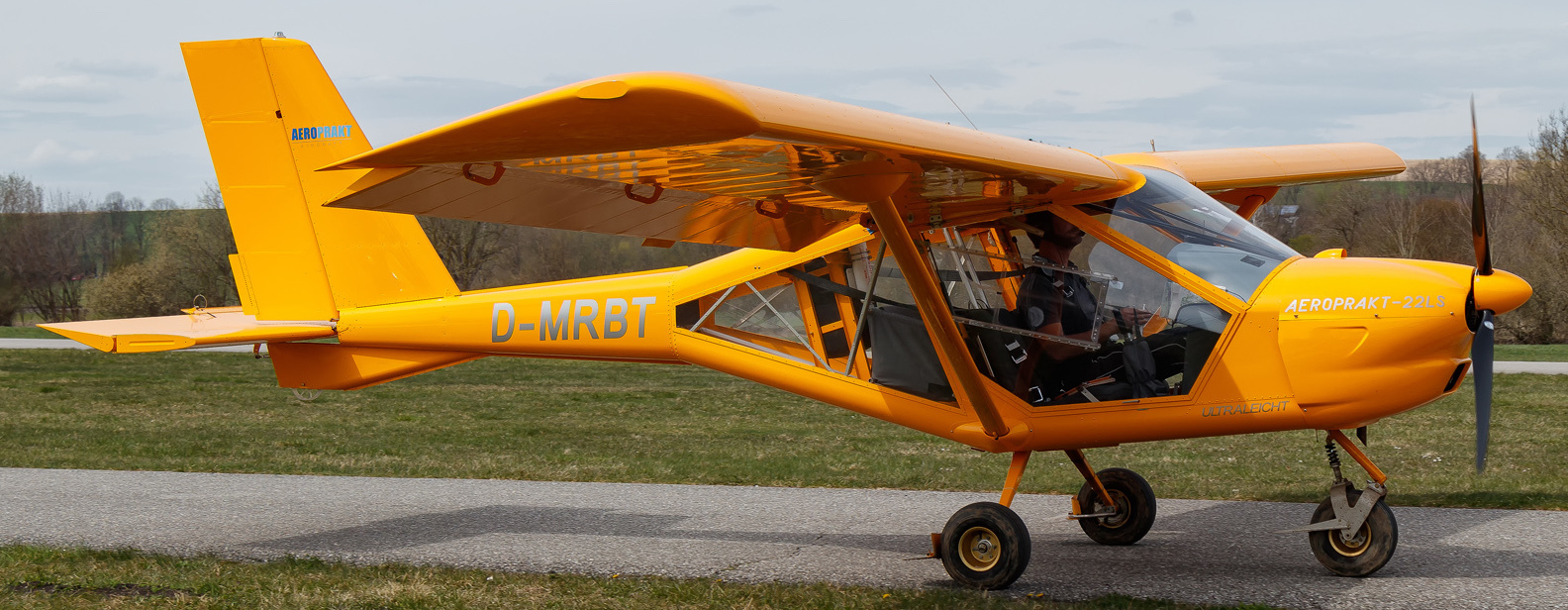
How much can come along? Enter crew, baggage and fuel – the page calculates take-off mass, free payload, centre of gravity and the expected take-off distance. The fixed values come from the flight and operating manual of the D-MRBT (edition A22LS-338-POH) and from the weighing report (DULV mass summary) of 22 March 2023.
A calculation aid, not a clearance. The operating manual and the valid weighing report are binding. Take-off distances below 600 kg are a rule-of-thumb estimate: the manual gives only a single value, namely the one at maximum take-off mass on asphalt in ISA at sea level with no wind.
Loading
Fuel gauge per tank: F about 42 l · ¾ about 32 l · ½ about 21 l · ¼ about 14 l · E about 4.5 l. Two tanks, 90 l together, of which 88 l usable.
Airfield and conditions
From airfield elevation, temperature and QNH the page calculates the density altitude of the departure airfield – the altitude the wing feels. Our airfield is preset at 2360 ft at standard temperature. The rule of thumb behind it: pressure altitude (airfield elevation plus 30 ft per hectopascal below 1013) plus about 120 ft per degree above standard temperature, which is 15 °C at sea level, 2 °C less per 1000 ft. In detail under Take-off Distance and Density Altitude.
Result
Please enter values.
Aircraft data from the weighing report
Both values come from the weighing report of 22 March 2023: empty mass 324.5 kg, CG 1.573 m behind the datum, giving 275.5 kg payload. They are preset and stay saved in this browser – change them here after a new weighing. Note: the yellow field on the cabin placard says 323.5 kg. This page calculates with the higher value from the weighing report.
What drives the take-off distance
Both charts calculate live with your inputs. The reference is the distance over a 15 m obstacle; the manual value for it is 335 m at 600 kg on asphalt at sea level.
From the manual value to your value
What density altitude does
What is used in the calculation
Limits (manual, sections 2 and 6): maximum take-off mass 600 kg · baggage at most 10 kg · minimum cabin load 55 kg · fuel capacity 90 l · CG in flight 1.524 to 1.660 m behind the datum, corresponding to 23.3 to 33.5 % MAC. With the 90-litre tanks the empty CG may lie between 1.491 and 1.583 m; the D-MRBT at 1.573 m is within that.
Lever arms (section 6.2): crew 1.600 m · fuel 2.000 m · baggage 2.300 m, each behind the datum, which is the engine flange. Fuel at 0.72 kg per litre.
Abbreviations: BE (Bezugsebene) is the datum, the zero line from which all lever arms are measured rearwards – on the A22LS the engine flange, i.e. the face on which the propeller sits. MAC is the mean aerodynamic chord; "30 % MAC" means the CG lies at 30 % of this chord behind the wing leading edge. Both refer to the same point: once in metres behind the engine flange, once as a share of the chord – and the range 1.524 to 1.660 m is the same as 23.3 to 33.5 % MAC.
Take-off distance: at 600 kg, ISA, sea level, no wind and a hard runway, the manual gives a ground roll of 105 m and 335 m over a 15 m obstacle. For lower masses the page uses the square of the mass ratio, for grass an addition of 20 or 30 % and 10 % per 1000 ft of density altitude – common rules of thumb, not manual values. Wind, runway slope and your own form on the day are not included.
Background: why on the A22LS the centre of gravity rather than the mass is the tighter limit is explained under Loading and Centre of Gravity.