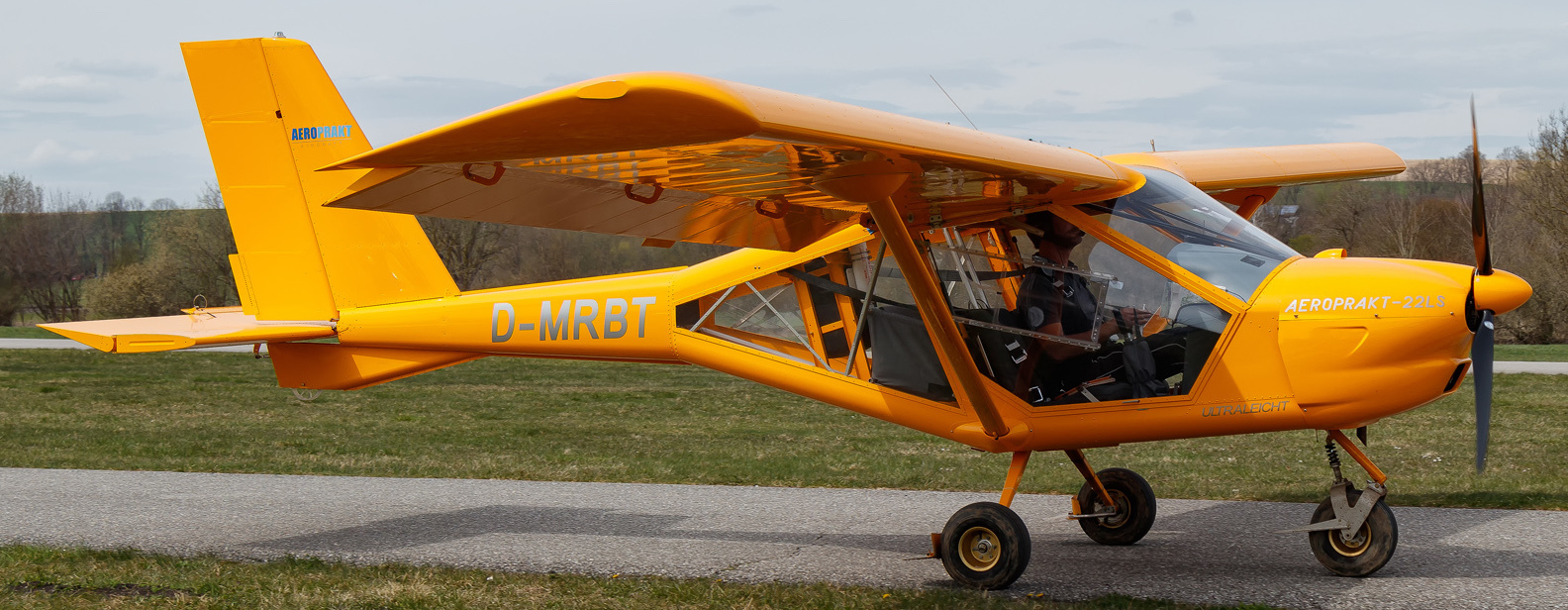
The Rotax 912 ULS is robust as long as you give it what it asks for: at least RON 95. The real question is not whether it runs, but what the fuel grade does to combustion chamber, oil and seals in the long run.
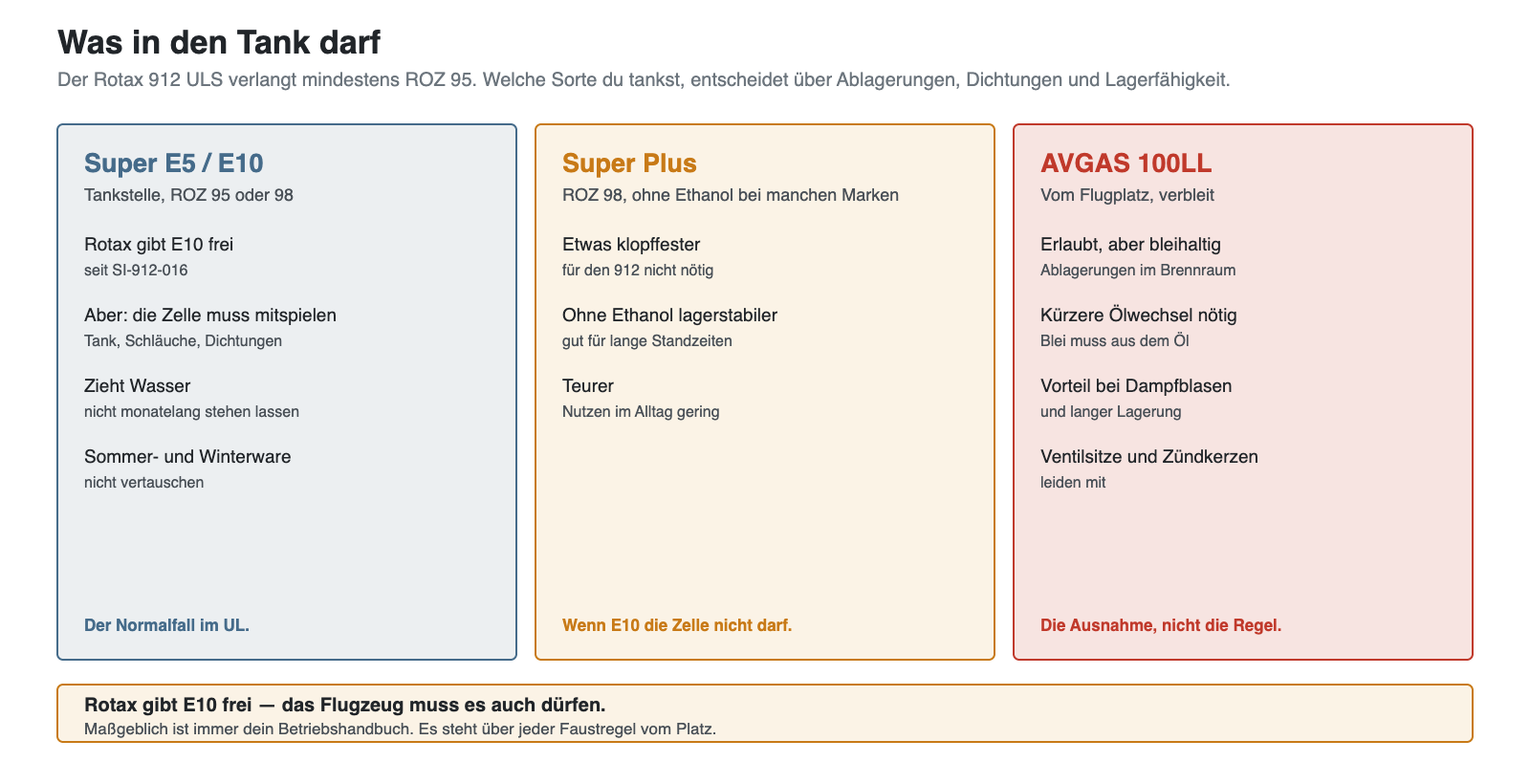
As of: October 2026. Sources are Rotax Service Information SI-912-016, the A22 operating manual and Aeroprakt Service Bulletin SB A-22LS-27. The manual of your aircraft together with the engine manufacturer's documentation is always binding, not this page.
RON 95 is the minimum, not the recommendation
The A22 manual lists two permitted grades: unleaded pump fuel with at least RON 95, or AVGAS 100LL. More octane does nothing for the 912; less costs it knock resistance. Premium with RON 95 is therefore not the compromise but the design point.
E10: Rotax says yes, the airframe has to agree
Rotax has explicitly approved the 912 series for E10. The decisive half-sentence follows right after: the operator must check with the airframe manufacturer whether tank, hoses and seals tolerate up to ten per cent ethanol. So the engine is not the bottleneck; the aircraft around it is.
For the A22 the question is answered: no E10. With Service Bulletin SB A-22LS-27 (September 2024), Aeroprakt limited the ethanol content for all A-22LS up to serial number 567 and all A-22L2 up to 608 to a maximum of 5%. The reason is the glass-fibre reinforced plastic tanks: ethanol attacks the epoxy resin and shortens their service life. For our D-MRBT this means: Super E5 or AVGAS 100LL. More on the page Safety and Maintenance D-MRBT.
Then there is the issue you notice in everyday life: ethanol attracts water. In a tank that stands half full in the hangar for weeks, moisture that was previously in the air collects. If you fly rarely, you are better off with ethanol-free fuel or a full tank.
AVGAS 100LL: permitted, but at a price
AVGAS is approved and has two real advantages: it stores well and is less prone to vapour lock. On the other hand it is leaded, and the lead does not stay in the exhaust. It is deposited in the combustion chamber and ends up in the oil, which is why Rotax requires more frequent oil changes with leaded fuel.
For continuous use it is therefore the poorer choice. As a reserve on a trip, when nothing else is available at the airfield, it is perfectly fine.
Summer grade and winter grade
Pump fuel is blended differently depending on the season. Winter grade is more volatile so that the engine starts in the cold — and that is exactly why it tends to form vapour bubbles in midsummer. Rotax puts it unmistakably: summer grade only in summer, winter grade only in winter. Anyone emptying a canister from December in March should know what they are doing.
The canister in the hangar
Petrol ages. After a few months it loses light components, the octane rating drops, and with ethanol blends water separates out. For the canister this means: buy small, turn it over often, store it dark and sealed — and when in doubt, put the rest in the car rather than the aircraft.
What this means for a flying day
- At the filling station take Super E5, not E10. The plastic tanks of the A22 tolerate a maximum of 5% ethanol (SB A-22LS-27).
- Drain before the first flight after a long period of standing. Water collects at the bottom, not the top.
- Put the aircraft away fully fuelled if it will stand for a longer time. Less air in the tank means less condensation.
- With AVGAS in the tank, keep the oil change interval in mind, not just at the next check.
- In midsummer, do not use up winter-grade fuel — vapour bubbles show up first on a hot start after the lunch break.
- New fuel grade, new look at the manual. What the engine may have is only half the answer.
Remember
RON 95 is the lower limit, E10 is off-limits for the A22 and AVGAS is a reserve, not a permanent state.