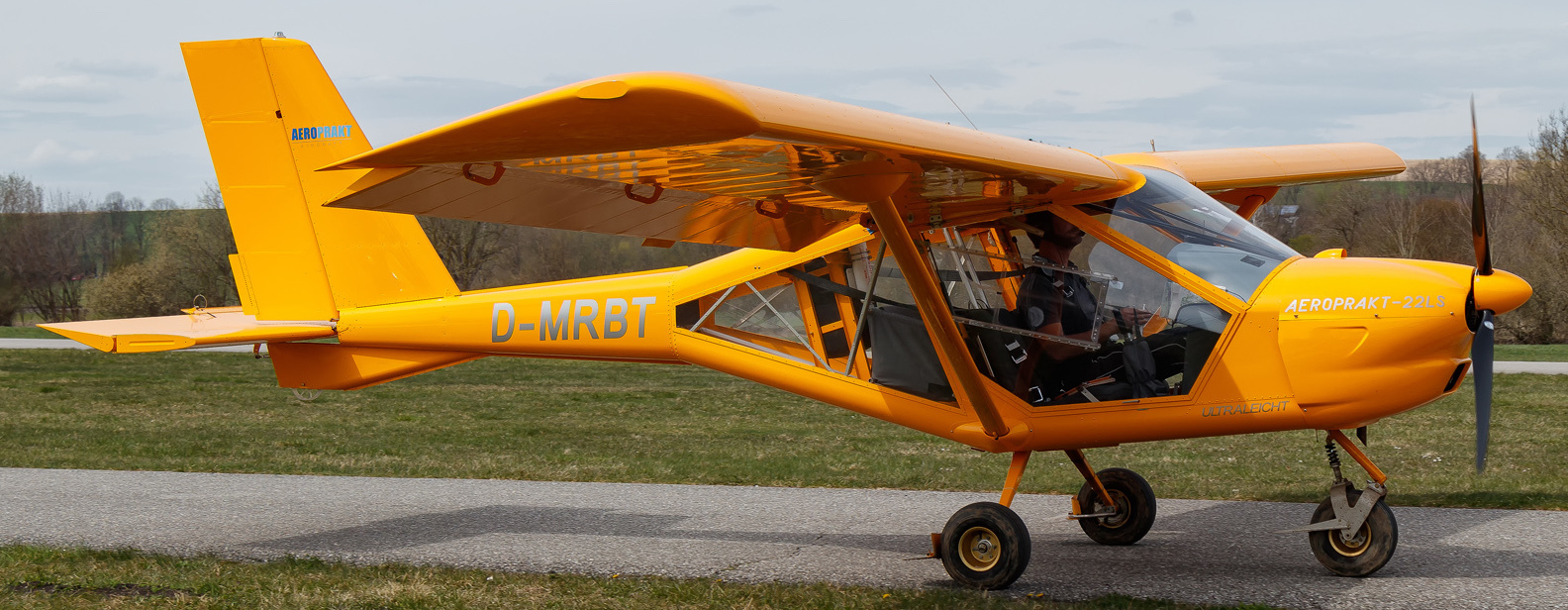
For a German ultralight, Italy is split in two: entry is free, but inside the country its own ultralight law applies, which was not made for you. If you know what Basico and Avanzato mean, you immediately understand why some airfields will take you and others will not.
As of: September 2026. The legal basis is DPR 133/2010; the airspace and airfield information comes from the AIP Italia of 3 September 2026 (ENR 1.2, ENR 5.5.4, GEN 1.2 and AD 1.3). The classification of German ultralights in Italy is legally unclear; this page is for orientation, not legal advice.
Entry itself is free
An ultralight registered in the EU does not need an entry permit for Italy. DPR 133/2010 admits aircraft from EU states without a procedure; only for aircraft from third countries does it require approval from the Aero Club d'Italia. Since 2022, 600 kilograms have also been permitted in Italy, so that issue is settled too.
Getting there is the real planning question: since 2021 Switzerland has required a paid permit for every ultralight entry. Via Austria it is simpler; German ultralights and licences are recognised there.
Basico and Avanzato
Airspace classes, radio, flight plan and the TMZ Italia are covered on the page Italy: Airspace, Radio and Flight Plan.
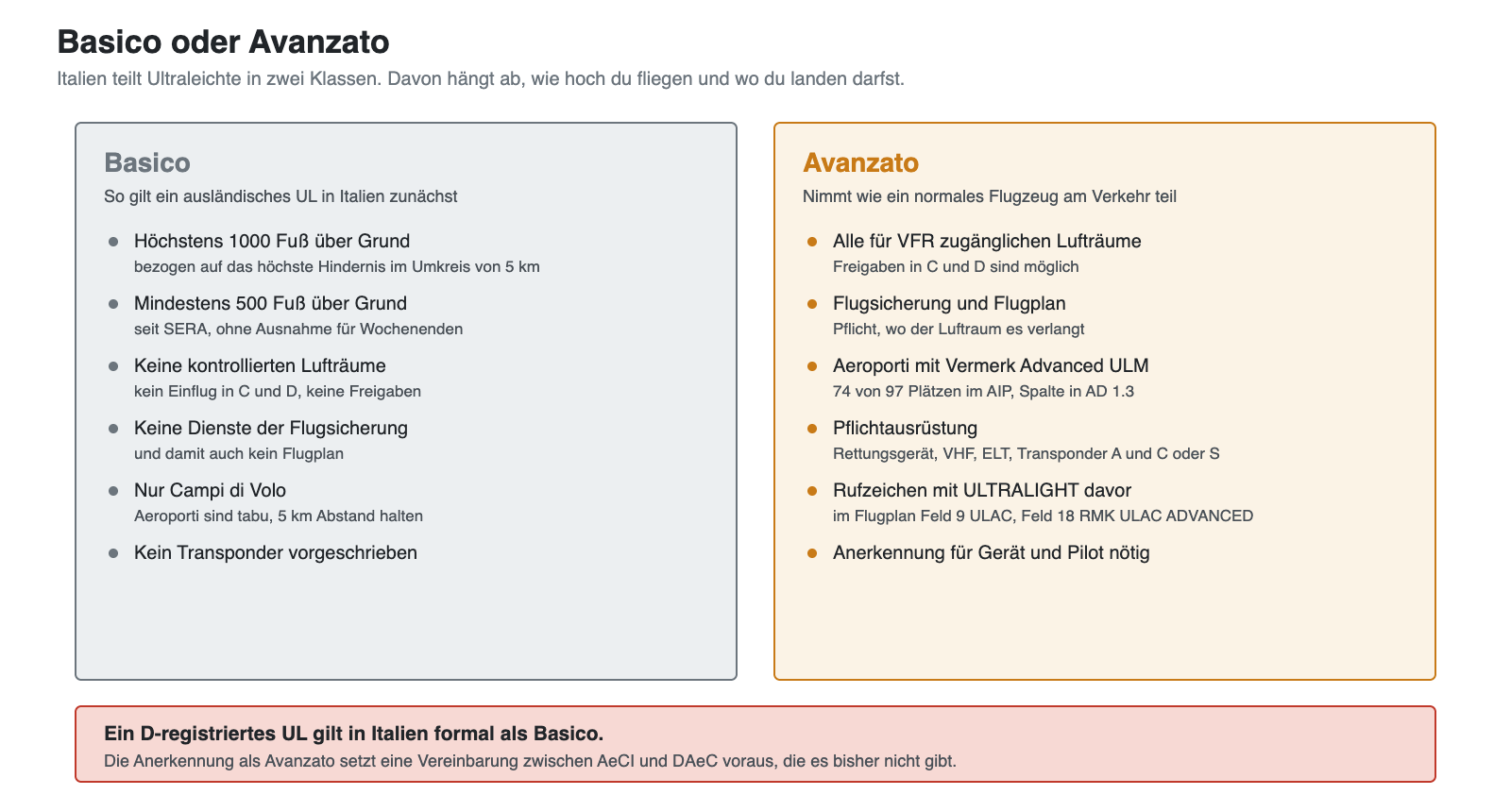
Italy divides its ultralights into two classes. Basico is the simple machine: at most 1,000 feet above ground, measured from the highest obstacle within five kilometres, at least 500 feet above ground, no controlled airspace, no air traffic services and therefore no flight plan either. Landings are made on campi di volo, not on AIP airfields.
Avanzato, by contrast, takes part in traffic like a normal aeroplane: all airspace accessible to VFR, clearances, flight plans, airfields. For this the regulations require equipment with a rescue system, VHF radio, ELT and transponder mode A and C or S, and they require it for aircraft and pilot together.
On the radio the Avanzati identify themselves: the word ULTRALIGHT goes in front of the callsign. In the flight plan, field 9 contains the designator ULAC and field 18 the remark RMK/ULAC ADVANCED.
The catch for D-registrations
Under DPR 133/2010, foreign aircraft and foreign pilots are initially regarded as Basico. Recognition as Avanzato requires an agreement between the Aero Club d'Italia and the DAeC, which does not yet exist. In the air, air traffic control generally treats an equipped German ultralight like an Avanzato; on the ground the paperwork may say otherwise. If you want to fly into an aeroporto, it is therefore better to ask in writing beforehand, stating type, approval, equipment and licence.
Which airfields you may fly to
The AIP answers the question cleanly: in the airfield list AD 1.3 there is the column VDS Avanzato / Advanced ULM with a clear yes or no. Of 97 airfields listed, 74 say yes.
- Open in the north: Bolzano, Brescia/Montichiari, Aosta, Parma, Rimini, Trieste/Ronchi, plus small airfields such as Verona/Boscomantico, Venezia/Lido, Padova, Milano/Bresso, Asiago, Belluno, Udine/Campoformido, Varese/Venegono, Valbrembo, Vercelli, Cremona/Migliaro, Ferrara, Massa Cinquale and Alzate Brianza.
- Closed: Bergamo/Orio al Serio, Bologna, Milano/Linate, Milano/Malpensa, Venezia/Tessera, Verona/Villafranca, Treviso, Torino/Caselle, Pisa, Firenze and Genova.
The list changes with every AIRAC cycle. Before planning it is worth checking the current AD 1.3; it is freely available online.
Campi di volo and aviosuperfici
Besides the AIP airfields, Italy knows two further categories, and the difference matters:
- Campo di volo: not a legal term but simply a suitable area. Article 6 of DPR 133/2010 permits take-off and landing with an ultralight on any suitable area if the owner agrees. There is no obligation to use airfields as in Germany, and therefore no complete directory either.
- Aviosuperficie: a registered private landing site that certified aircraft may also use. Here too: you obtain the operator's permission beforehand; it does not follow from the publication.
If you are looking for such sites, there is no way round the Avioportolano. It lists the sites whose operators welcome guests, with runway, contact and conditions. The data also feeds into SkyDemon and EasyVFR.
Ultralight zones and corridors
In section ENR 5.5.4 the AIP lists its own ultralight areas and corridors, mostly as narrow tubes up to 500 feet above ground that keep airfields within large control zones accessible. The catch is in the same table: use is tied to coordination with the responsible control unit and often to the local club. For visitors passing through, they are not a shortcut.
Border, customs and reports
A flight plan is mandatory for the flight across the national border. Within the EU you may also fly to an airfield without customs clearance, without an intermediate landing, if everyone on board has valid papers; this fact belongs in field 18 of the flight plan. If there is no border authority at the destination, you report the airfield of origin or destination and the number of occupants to the responsible airport directorate at least three hours before landing.
What this means for a trip to Italy
- Plan via Austria, not via Switzerland.
- Ask the destination in advance if it is an aeroporto, and take the answer with you.
- Check AD 1.3: if the Advanced ULM column says no, asking will not help either.
- Complete equipment: radio, transponder, ELT and rescue system are what make you credible in Italy.
- Campi di volo are private land, not public airfields. Clarify condition and consent beforehand.
Where to look it up
The legal basis is DPR 133/2010; the airfield question is answered by AD 1.3 of the AIP Italia, the ultralight areas are in ENR 5.5.4 and the height rule for ultralights in ENR 1.2. In practice, the private site fliegen-in-italien.de by Philipp Tiemann is the most detailed German-language source; you will find the landing sites in the Avioportolano.
Remember
Entry is free, the status is not. Legally you are Basico, in practice you fly like an Avanzato — and you close that gap with complete equipment and an enquiry in advance.