Almost everything we fly takes place in airspace E. It is controlled airspace – and yet VFR may enter without clearance, without radio and, in large parts, without a transponder. That sounds more relaxed than it is: in the same layer IFR traffic descends on approach, and it will not necessarily see you.
Where E begins and ends
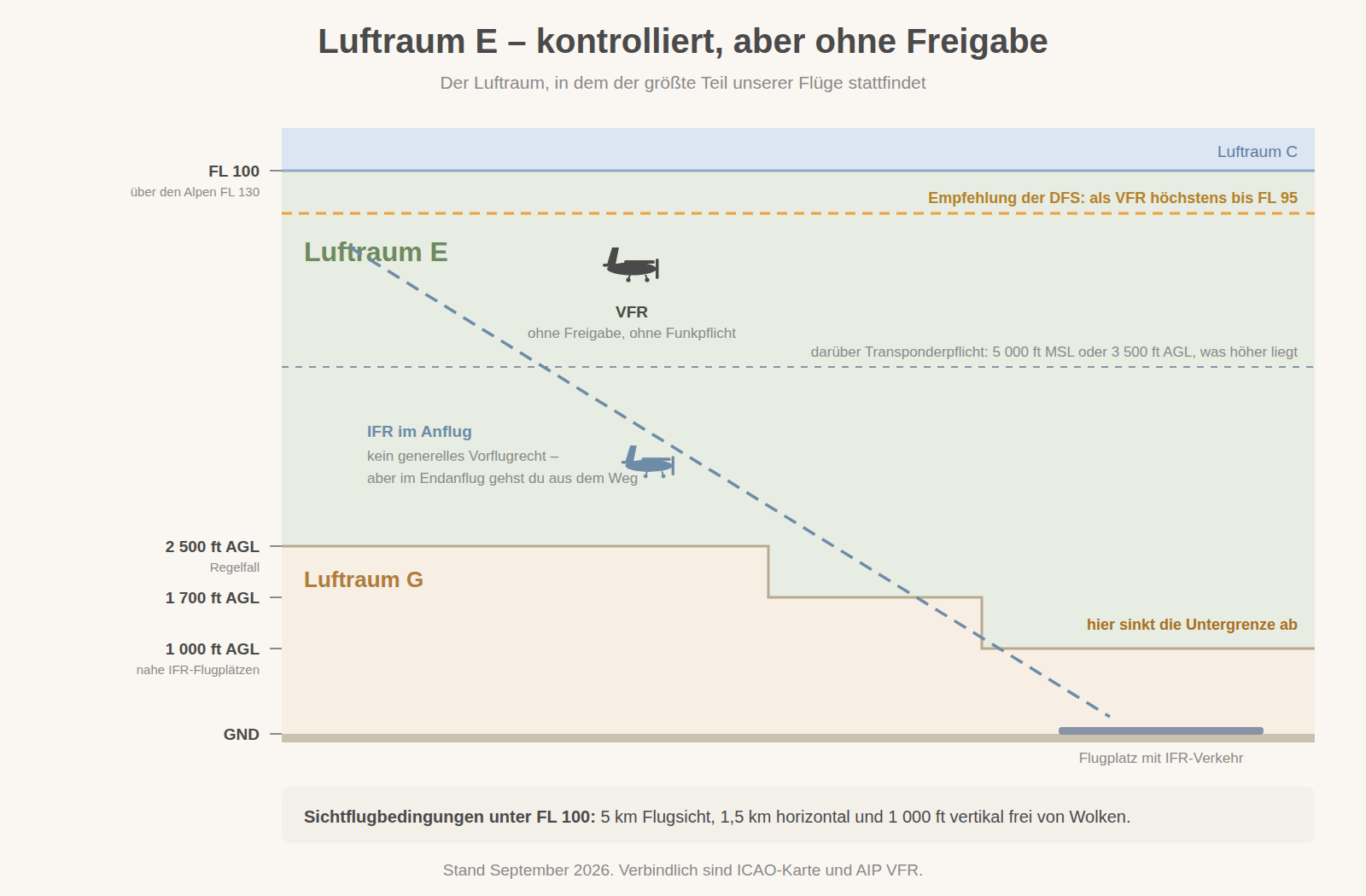
- Lower limit – normally 2,500 ft above ground. Near airfields with IFR traffic it drops to 1,700 or 1,000 ft. Which value applies is on the ICAO chart, not in your head.
- Upper limit – FL 100, over the Alps FL 130. Above that airspace C begins, and nothing works there without clearance.
- Below lies airspace G. The transition is not a formality: the visual flight conditions change with it.
Who you will meet there
Airspace E is the only controlled airspace in which IFR and VFR fly side by side without anyone separating them from each other. DFS explicitly states that IFR flights there have no general right of way. You must still give way: to aircraft on final approach and to landing aircraft.
In practice this means: the traffic you meet there is fast, often has no view outside and does not expect you. DFS therefore recommends that VFR pilots use airspace E only up to FL 95 – that leaves a layer of air between you and the IFR flights at FL 100.
What you have to carry
- Transponder above 5,000 ft MSL or 3,500 ft above ground, whichever is higher; always at night. The VFR code is 7000.
- Radio is not mandatory by day. At night it is required outside the aerodrome area.
- Visibility and distance from cloud below FL 100: 5 km flight visibility, 1.5 km horizontally and 1,000 ft vertically clear of cloud. That is considerably more than airspace G requires – and it is the reason why on hazy days you can suddenly become illegal without having changed altitude.
What this means for a flying day
- Transponder on, code 7000, even below the mandatory altitude. It costs nothing and makes you visible to traffic that would otherwise not find you.
- Treat FL 95 as a self-imposed lid. For an ultralight that is rarely a restriction anyway.
- Give IFR airfields a wide berth instead of pushing the lower limit. An approach is predictable from ten miles out – if you expect it.
- Call FIS even though you don't have to. Traffic information in airspace E is exactly what is missing there.
- If visibility drops, descend in good time. Lower minima apply below the E base – but that is a decision, not a rescue: lower means closer to the ground and to obstacles.
As of September 2026. Airspace boundaries change regularly, most recently on 19 March 2026. The current ICAO chart and the AIP VFR are binding – not this page.
Remember
Nobody separates you in airspace E. If you fly there without transponder and radio, you are relying on your own eyes alone – against traffic that is twice as fast.