Besides the airspace classes there are zones that trigger exactly one additional obligation – and only that one. They are regularly confused, yet the distinction is simple: the first wants a word, the second a code, the third a decision before take-off.
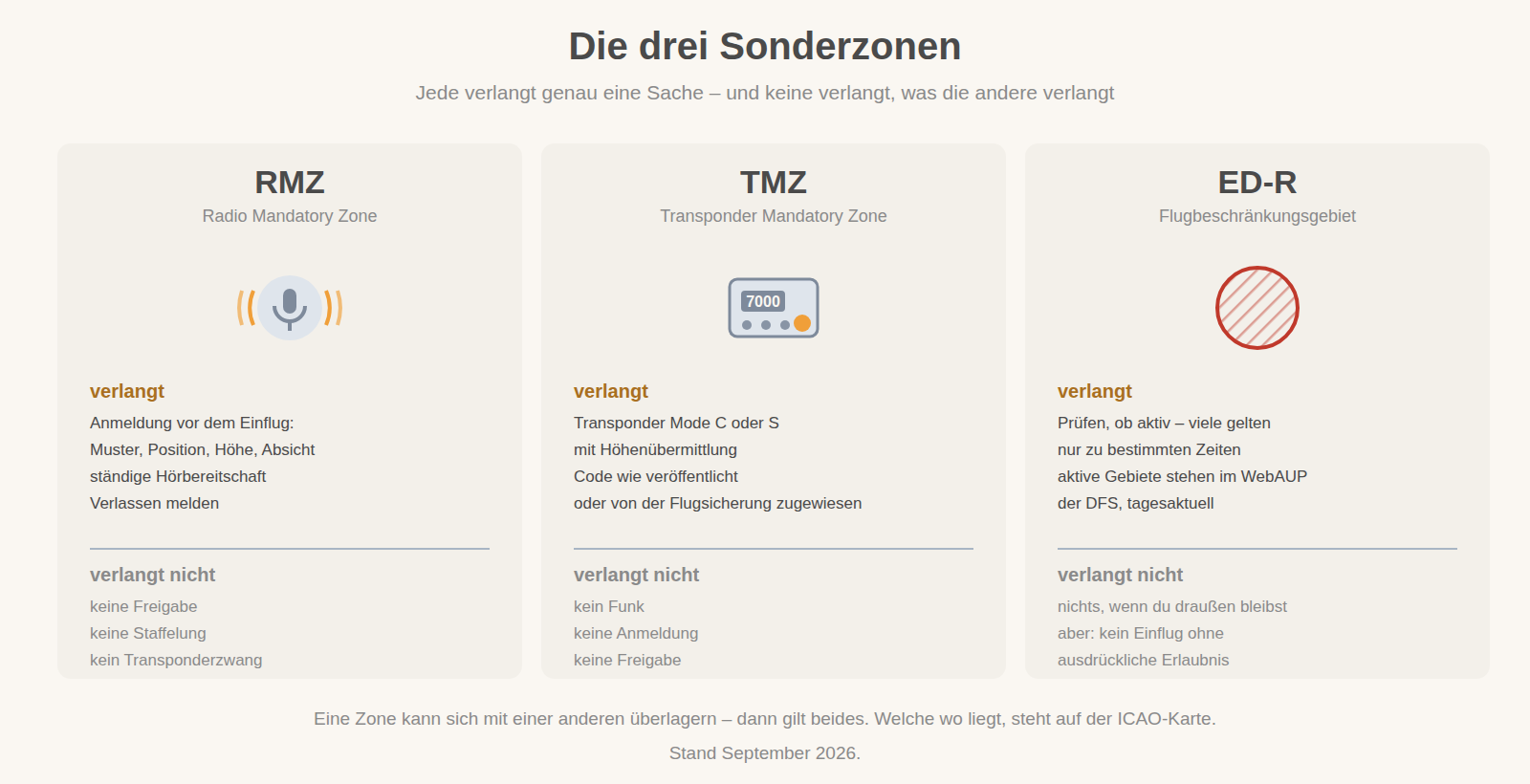
RMZ – a word
The Radio Mandatory Zone came to Germany in 2014 as a replacement for the abolished airspace class F. It usually lies around airfields without a control zone that nevertheless have IFR arrivals and departures, and it makes sure everyone knows about everyone else.
- Report before entering: type, position, altitude and intention.
- During the flight maintain a continuous listening watch.
- Report leaving.
What the RMZ is not: a control zone. There is no entry clearance, nobody separates you and nobody assigns you an altitude. You get traffic information – but no more than that.
TMZ – a code
In the Transponder Mandatory Zone the transponder must be running with altitude reporting, mode C or S. The code is either on the chart or assigned to you by air traffic control. No talking is required: a TMZ demands neither radio nor a report.
The purpose is the same as with the RMZ, only by other means: IFR traffic should be able to see you. Anyone without a suitable transponder on board has to go around – and that definitely affects older ultralights.
ED-R – a decision
Restricted areas are the most changeable part of the airspace. Some are permanent, many only active at certain times, and the set changes every year. On 19 March 2026, for example, ED-R 18 Ahaus, ED-R 19 Gorleben, ED-R 20 Greifswald/Lubmin, ED-R 28 Annaburger Heide and ED-R 29 Schönewalde were added; ED-R 39 Obrigheim was removed, and the times of activity at Siegenburg were changed.
Whether an area is active today is shown in the DFS WebAUP. That is the same service that the daily weather briefing embeds – a look that costs two minutes before take-off.
Administrative offence or criminal offence – here two worlds part
In the cockpit both look the same: one glance at the chart too few. Legally it is a fundamental difference.
Controlled airspace without clearance
Administrative offence
That is, airspace C or D and the control zone. The legal basis is Section 44 LuftVO in conjunction with Section 58 LuftVG; the infringement is prosecuted by the Federal Supervisory Authority for Air Navigation Services (BAF) in fine proceedings. The statutory range goes up to 50,000 euros; in practice it stays at amounts in the hundreds to low thousands.
ED-R or prohibited area without permission
Criminal offence
The areas themselves are established under Section 17 LuftVO; entering them is a criminal offence under Section 62 LuftVG: imprisonment of up to two years or a fine, in the case of negligence up to six months or a fine of up to 180 daily rates. The public prosecutor investigates – criminal proceedings, not fine proceedings.
And negligence is explicitly included: anyone who simply overlooked the area does not fall outside criminal law, only into the lower penalty range. An honest mistake does not turn the criminal offence into an administrative one.
In short: in airspace C the mistake costs money, in an ED-R it means criminal proceedings.
What this means for a flying day
- On the chart, look for the zones first, then for the route. An RMZ is easily overlooked because it is shown with an inconspicuous dashed line.
- In the RMZ, what counts is reporting, not asking. You do not request anything, you just say who and where you are.
- Zones can overlap. If a TMZ lies over an RMZ, both apply: set the code and report.
- Check ED-Rs on the day of the flight, not the evening before. Temporary areas are activated at short notice.
- Without a suitable transponder, plan to go around rather than balancing on the edge of a TMZ.
As of September 2026. Airspace boundaries change regularly, most recently on 19 March 2026. The current ICAO chart and the AIP VFR are binding – not this page.
Remember
RMZ means talk, TMZ means code, ED-R means decide beforehand. None of the three is a clearance – and none replaces a look at the chart.