Italy begins beyond the Brenner, and in aviation terms a different system begins there. Three things you notice immediately: below FL 195 the airspace is basically G, over Milan and Rome there is a class that no clearance will get you into, and the whole country is a transponder mandatory zone.
As of: September 2026. The figures come from the AIP Italia, AIRAC edition of 3 September 2026 (ENR 1.1, ENR 1.2, ENR 1.4, ENR 1.6, ENR 1.7, ENR 1.10, ENR 2.1.1 and GEN 1.2). The ENAV AIP, the NOTAM and the current chart are binding, not this page.
G at the bottom – all the way up to FL 195
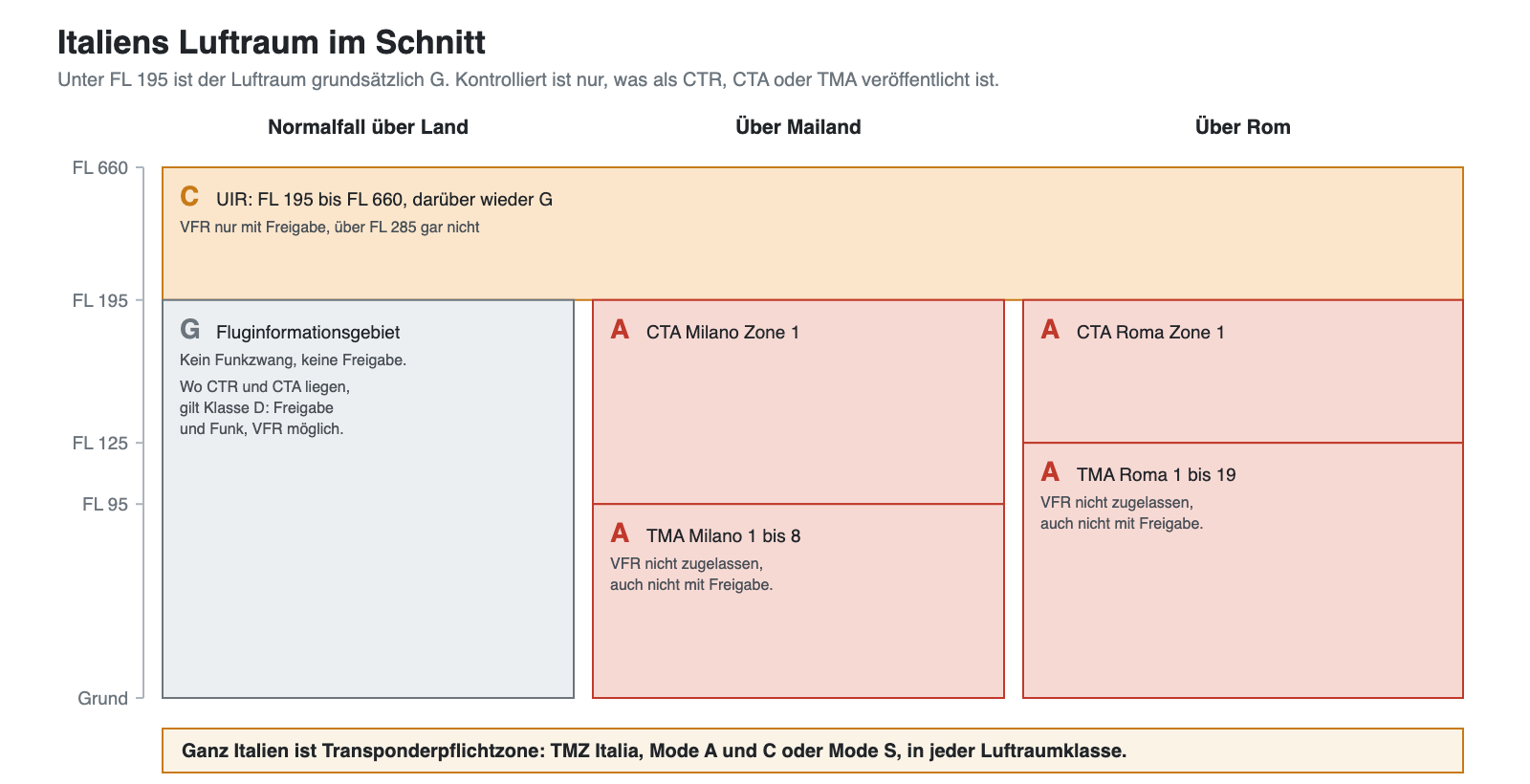
Germany puts airspace E over almost everything, usually from 2,500 feet above ground. Italy does the opposite: the flight information regions Milano, Roma and Brindisi are classified as class G from the ground to FL 195. Only what is explicitly published as a control zone, CTA or TMA is controlled.
For you this means: on the way from the border to Lake Garda or down the Adriatic you are mostly in uncontrolled airspace, without clearance and without mandatory radio. The controlled parts, on the other hand, are clearly outlined on the chart, and they begin where the commercial airports are.
The class we do not have
Over Milan and Rome there is airspace A. The Milano TMA with its zones 1 to 8 extends to FL 95, above it the Milano CTA zone 1 continues to FL 195, both class A. Over Rome the TMA with 19 zones extends to FL 125, above it the Roma CTA zone 1 to FL 195. Zone 2 of the Malpensa control zone is also class A.
VFR is not permitted in class A. This is not a case of asking early enough but a wall: you plan around the outside or underneath. The other control zones and CTAs are class D, where the familiar routine of call, clearance and listening watch applies.
All of Italy is a TMZ
The airspace of the three FIRs and UIRs is designated as TMZ Italia. Aeroplanes, helicopters and advanced ultralights must carry a transponder with mode A and C or mode S – in every airspace class, including G. Other aircraft need it in classes A to E.
Without instructions from air traffic control, you squawk 7000 if nobody is providing you with a service, and 2000 if you are in contact but have not been assigned a code.
The semicircular rule is rotated
Above 3,000 feet above ground the cruising level rule also applies in Italy, but with different sectors than at home: instead of tracks 000 to 179 degrees the range is 090 to 269 degrees, and instead of 180 to 359 degrees it is 270 to 089 degrees. Italy has adapted the division to the main traffic flows in the country.
In practice this means: on a northerly track up the Adriatic you fly the altitudes you would fly on a westerly track at home. If you are not aware of this, you are on the wrong side of the rounding.
Transition altitude: one per airfield
There is no nationwide transition altitude. The AIP lists it for each airfield, and it is usually between 5,000 and 7,000 feet. Bolzano has 10,000 feet, Aosta 15,000, Lampedusa 4,000. You are given the transition level on approach.
Radio: Italian is allowed, English not everywhere
At and below FL 195, Italian or English may be spoken under VFR; above that and under IFR only English. At some airfields ENAC prescribes English for VFR too: Malpensa, Linate, Fiumicino, Venezia/Tessera and Bergamo for runway 10/28. At Bologna, Catania, Palermo, Napoli and Bergamo 12/30 this applies to everyone who holds an English language proficiency endorsement.
The flight information service is called Informazioni. Two centres are responsible for the north:
- Milano Informazioni on 135.075, 124.925 and 128.925 MHz, 0600 to 2200 UTC, in summer 0500 to 2100. After that Milano ACC takes over on 125.275.
- Padova Informazioni on 124.150 and 126.425 MHz, same hours. Outside those hours FIS runs on 120.725 or 134.750 MHz.
Report before the border
This is something you do not know from Germany: anyone entering the Milano, Roma or Brindisi FIR from abroad must have established two-way radio contact with the responsible air traffic services unit beforehand. VFR and IFR alike, and explicitly regardless of which airspace class lies at the border. The call to Padova or Milano Informazioni is therefore part of the border crossing, even if you are flying in G.
Flight plan
A flight plan is required for every flight that uses air traffic control, for every flight across a national border (exception: San Marino) and for night flights that leave the circuit. It must be filed at least 30 minutes before take-off.
If you fly without a flight plan but still use the radio, say so: type, VFR, no flight plan. There is then no alerting service.
What this means for a flying day
- The border is a radio call. Establish contact with Padova or Milano Informazioni before you reach the FIR.
- Transponder on, always. Without mode A and C or S you are not compliant in Italy, even in G.
- Plan well around Milan and Rome. Class A cannot be requested.
- Choose your cruising altitude according to the Italian sectors as soon as you are above 3,000 feet above ground.
- Look up the transition altitude of your destination beforehand. It is different at every airfield.
And with an ultralight?
For ultralights Italy has its own rulebook that goes beyond the airspace question: height limits, landing sites and the difference between Basico and Avanzato are explained on Italy with an ultralight.
Where to look it up
ENAV publishes the eAIP Italia online, with one edition per AIRAC cycle. The sections relevant to this page are ENR 1.4 for the airspace classes, ENR 1.2 for the VFR rules, ENR 1.6 for the transponder, ENR 1.7 for the altimeter and cruising levels, ENR 1.10 for the flight plan, ENR 2.1.1 for the FIRs and their frequencies and GEN 1.2 for entry and customs. Plus, before the flight, the NOTAM and the current chart.
Remember
Italy is more open at the bottom and stricter at the top. If you call the border, keep the transponder running and plan around Milan and Rome, you have the essentials covered.