Austria is close, and the way there is shorter than the list of things that are different. Four of them you notice immediately: the airspace is more open at the bottom, D instead of C sits above E, the transition altitude is twice as high – and your transponder decides whether you need a flight plan.
As of September 2026. The figures on this page come from the AIP Austria, edition of 4 September 2026 (ENR 1.4, ENR 1.6, ENR 1.7, ENR 1.10, ENR 2.1, GEN 1.2 and GEN 1.5). Airspace boundaries and procedures change; the Austro Control AIP is binding, not this page.
More G at the bottom than at home
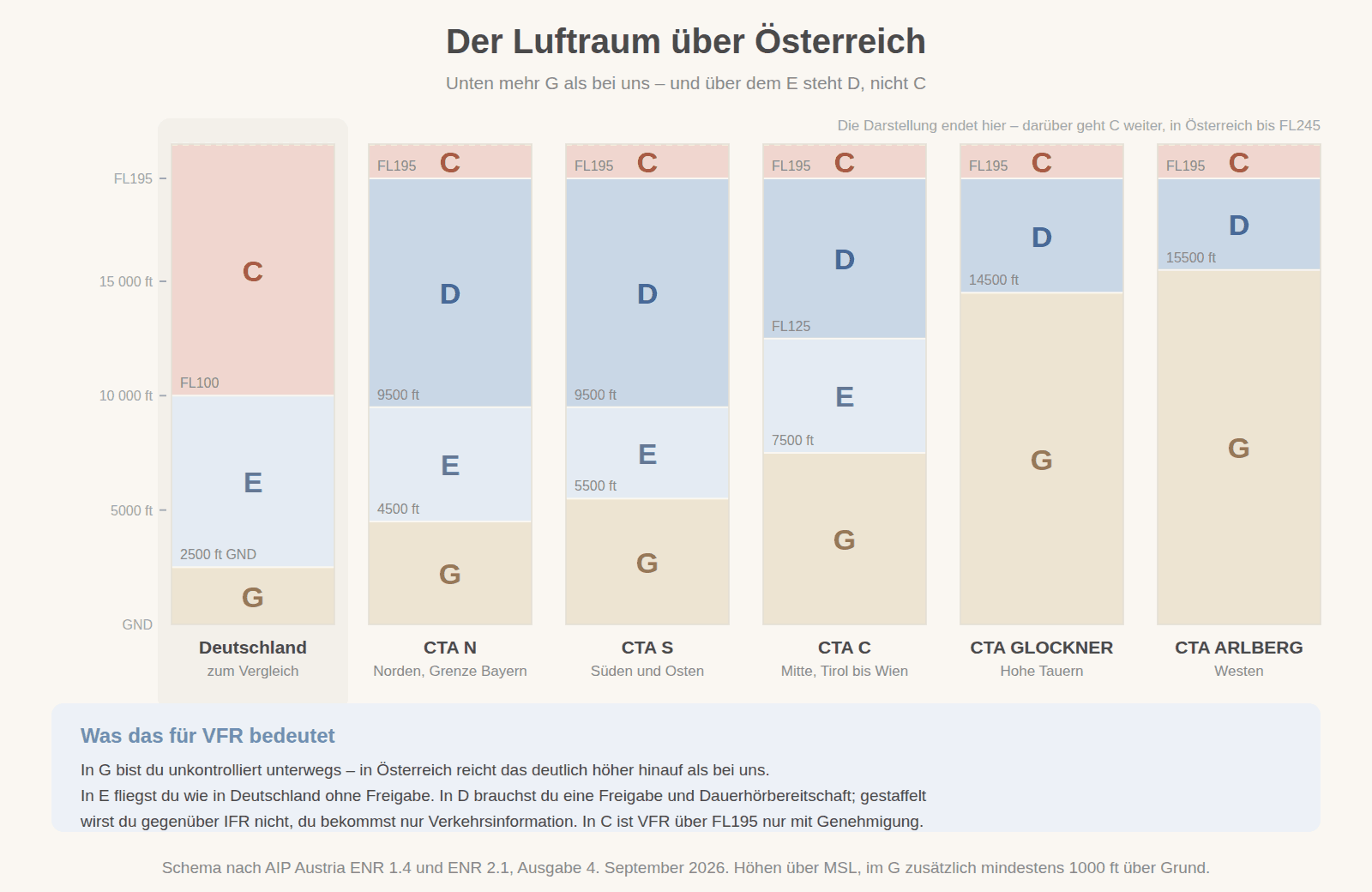
In the Vienna FIR there are only four airspace classes: C, D, E and G. A, B and F do not occur. The biggest difference from Germany is at the bottom. In Germany controlled airspace E usually begins at 2,500 feet above ground. In Austria you stay in G considerably longer: in the North sector along the Bavarian border up to 4,500 feet MSL, in the south and east up to 5,500, in the middle of the country up to 7,500 feet. Over the Hohe Tauern G reaches 14,500 feet, in the west over the Arlberg even 15,500.
These figures are altitudes above MSL. Over high terrain a second rule applies: controlled airspace never begins lower than 1,000 feet above ground. Over an 8,000-foot ridge in the North sector, the base of E is therefore not at 4,500 feet but at 9,000.
Above E sits D, not C
In Germany airspace C lies above FL 100, and VFR has no business there without clearance. In Austria E is followed first by D – in the north and south from 9,500 feet, in the middle of the country from FL 125, over the Arlberg and Glockner directly above G. D extends to FL 195; only above that does C begin, up to FL 245.
In practice this means: you may fly VFR there. But not just like that.
VFR in airspace D
- A clearance from air traffic control is a prerequisite. Obtain it before entering, not afterwards.
- Continuous listening watch on the assigned frequency.
- You are not separated from IFR traffic. You get traffic information; seeing and avoiding is up to you.
- Above FL 195 VFR is only permitted with approval, above FL 285 not at all.
Your transponder decides whether you need a flight plan
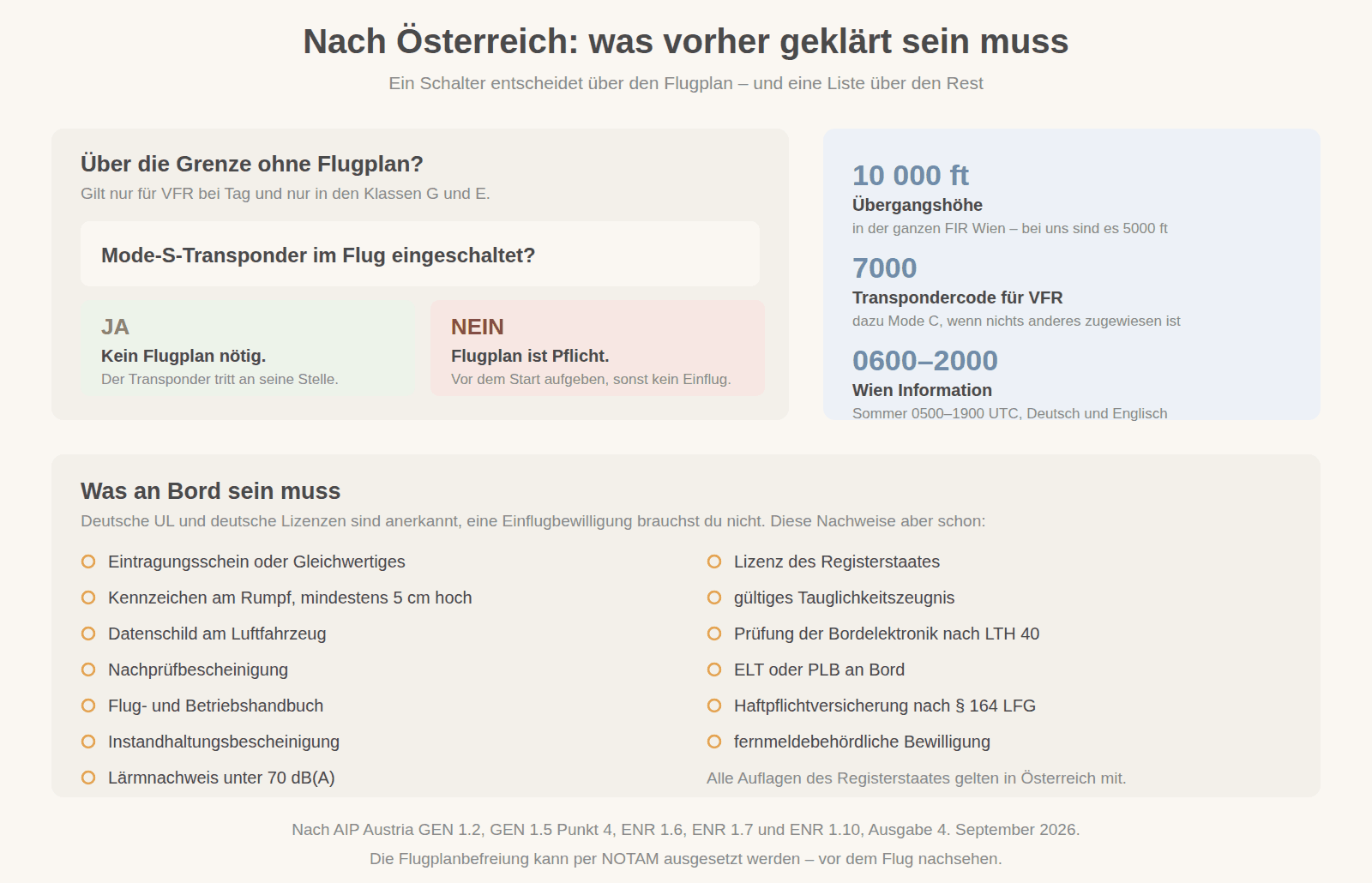
For every flight across a national border a flight plan must be filed in principle. For VFR flights by day in classes G and E there is an exception – with one condition: anyone entering the Vienna FIR in a powered fixed-wing aircraft, a helicopter or a gyroplane needs a Mode S transponder switched on in flight. Without Mode S the flight plan remains.
If you fly without a flight plan, transmit the registration as the aircraft identification. And the exception itself is not set in stone: it can be restricted temporarily by NOTAM. That belongs in flight planning, not in memory.
Transition altitude: 10,000 feet
Throughout the Vienna FIR the transition altitude is 10,000 feet MSL – twice as high as the 5,000 feet you know from Germany. Below it you fly altitudes above MSL on QNH, above it flight levels on 1013. Because of the mountains the actual transition level may differ; on approach air traffic control will tell you.
The VFR transponder code is 7000, as at home, with mode C, unless someone assigns you something else.
Radio: Wien Information closes in the evening
The flight information service is called "Wien Information" and speaks German and English. Unlike Langen Information, however, it is not staffed around the clock: 0600 to 2000 UTC, in summer 0500 to 1900. If you are still flying in the evening, you should have planned for that.
"Wien Radar" is available continuously and works in English, German on request. The fact that German is spoken in Austria does not replace the BZF I, however: the BZF II only entitles you to radiotelephony in German airspace.
The frequencies are in the AIP: the Flight Information Centre Wien works on 134.625 and 124.400 MHz, plus 118.525 MHz via Vienna approach control. Anyone who wants to pass through C or D states the request on the initial call to "Wien Information" and not directly to the control unit – this needs advance notice and must be planned for.
What must be on board
First the good news for ultralights: German ultralights and German licences are recognised in Austria; you do not need an entry permit under Section 18 of the Austrian Aviation Act. The same applies to Croatia, Slovakia, Slovenia, the Czech Republic and Hungary.
In return, what has to be carried is precisely defined:
- Certificate of registration or equivalent
- Registration marks on the fuselage, at least 5 cm high
- Data plate on the aircraft
- Certificate of the periodic inspection
- Flight and operating manual
- Maintenance certificate
- Noise certificate below 70 dB(A), measured 2.5 km from the point of departure
- Licence of the state in which the aircraft is registered
- Valid medical certificate
- Periodic inspection of the avionics according to LTH 40 or equivalent
- ELT or PLB
- Liability insurance according to Section 164 LFG or Regulation (EC) 785/2004
- Radio station licence
Experience shows that two items stand out: the noise certificate and the ELT or PLB. And regardless of this list: all conditions and operating limitations of your state of registry also apply in Austria. What your operating manual forbids at home remains forbidden there too.
Where to look it up
Austro Control publishes the AIP Austria online as an eAIP, plus the online chart "VFR Austria". The sections relevant to this page are ENR 1.4 for the airspace classes, ENR 2.1 for the boundaries of the individual sectors, ENR 1.6 for the transponder, ENR 1.7 for the altimeter, ENR 1.10 for the flight plan and GEN 1.2 and GEN 1.5 for entry and equipment. Before the flight, NOTAM and the current ICAO chart are added.
Further south: beyond the Brenner a different system begins. Airspace G up to FL 195, class A over Milan and Rome, transponder requirement throughout the country and a rotated semicircular rule are described on Italy: Airspace, Radio and Flight Plan, Italian ultralight law on Italy: Flying an Ultralight.