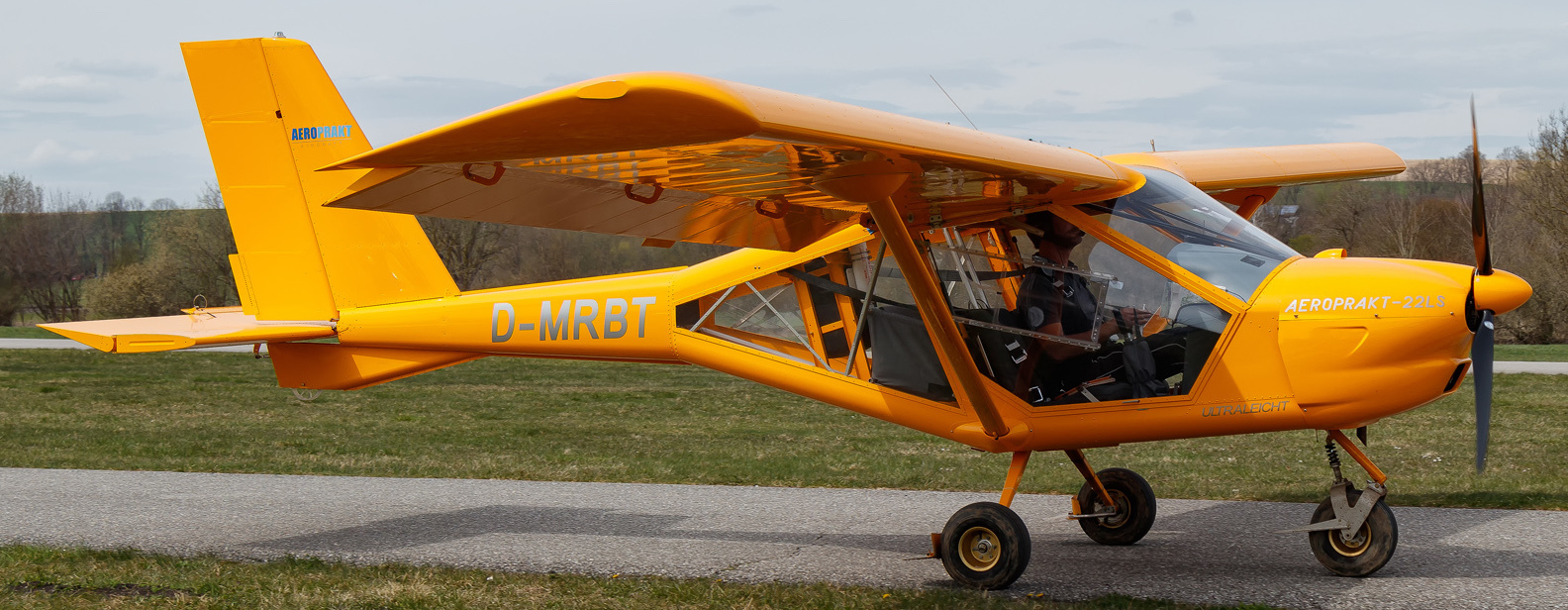
The altimeter is a barometer with a height scale. It does not measure the distance to the ground but air pressure – and anything that changes the pressure changes the reading. That is why three things must be right: the setting before take-off, the pressure change en route and the temperature.
The three settings
With the knurled knob you set the reference pressure to which the reading should relate. Three values are in common use, and they answer three different questions.
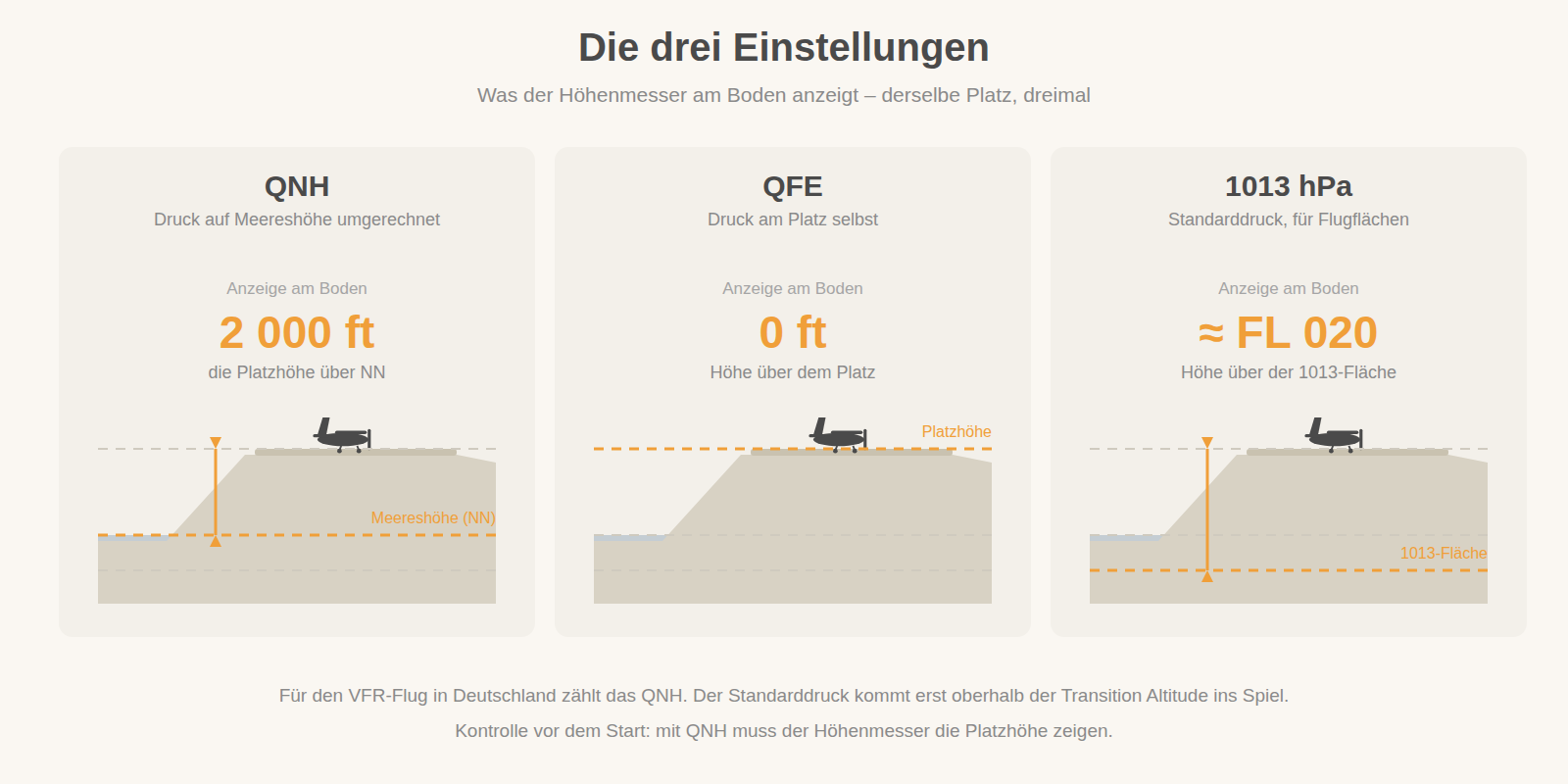
- QNH – the pressure reduced to sea level. On the ground the altimeter shows the airfield elevation above mean sea level. This is the setting for VFR flight, and terrain heights and airspace limits refer to it.
- QFE – the pressure at the airfield itself. On the ground the reading is zero. Unusual in Germany, but still found in gliding and abroad.
- 1013.25 hPa – standard pressure. Above the transition altitude everyone flies on the same scale so that separation between aircraft is correct. In Germany it is usually 5,000 ft; neighbouring countries use other values, which are shown on the chart.
The check before take-off is as natural as checking the oil: set the QNH, and the needle must show the airfield elevation. If it is off by more than about 50 ft, either the value or the instrument is wrong.
Two errors that add up
Two effects make the reading too high, and both point in the same direction: you are lower than the needle says. Neither can be seen on the instrument.
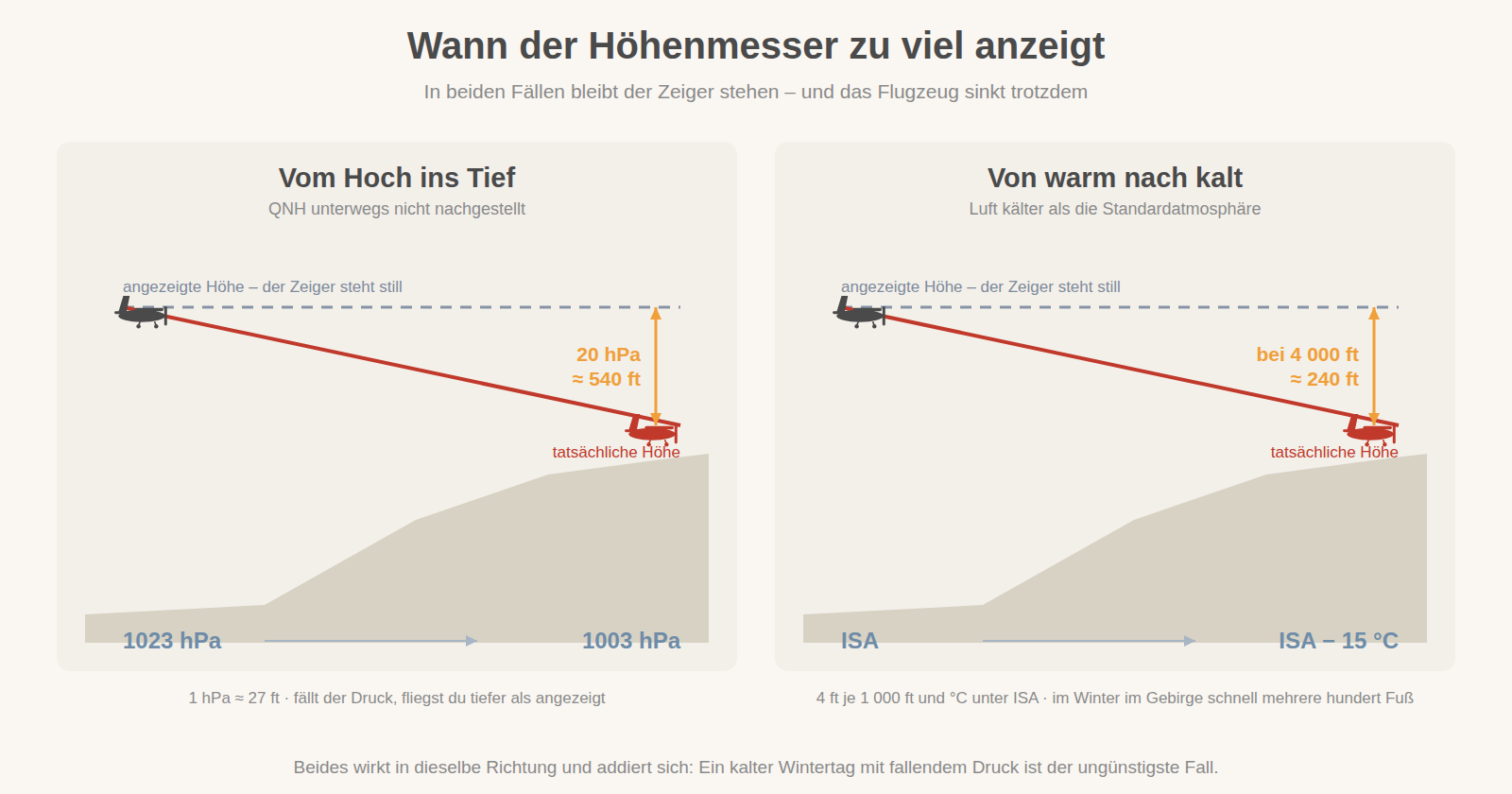
- Falling pressure – 1 hPa corresponds to about 27 ft. If you fly from a high of 1023 hPa into a low of 1003 hPa without resetting the QNH, the altimeter reads a good 540 ft too high.
- Cold air – the scale is calibrated for the standard atmosphere. For every degree below ISA you lose about 4 ft per 1,000 ft above the reference surface. At 15 degrees below ISA and 4,000 ft, that is about 240 ft.
- Both together – a cold winter day with falling pressure is the worst case, and that is exactly when people like to fly over the snow-covered mountains.
What this means for a flying day
- Set the QNH again before every take-off and check it against the airfield elevation. Yesterday's value is wrong today.
- Set too high is the terrain problem, set too low the airspace problem. A QNH set too high shows more altitude than you have; one set too low makes you fly higher than you think. Under the Munich TMA, the second direction is the expensive one.
- On longer routes, update the QNH en route via ATIS or FIS. Two pressure systems over 200 km are nothing unusual.
- In winter, add a margin over the mountains. Minimum altitudes are indications, not reality – a pass crossing with a tight margin is no longer a tight margin at minus ten degrees.
- When crossing the border, the transition altitude changes. Austria and Switzerland do it differently from Germany.
Remember
The altimeter shows pressure, not height. Flying from high to low and from warm to cold, you are lower than the needle says.