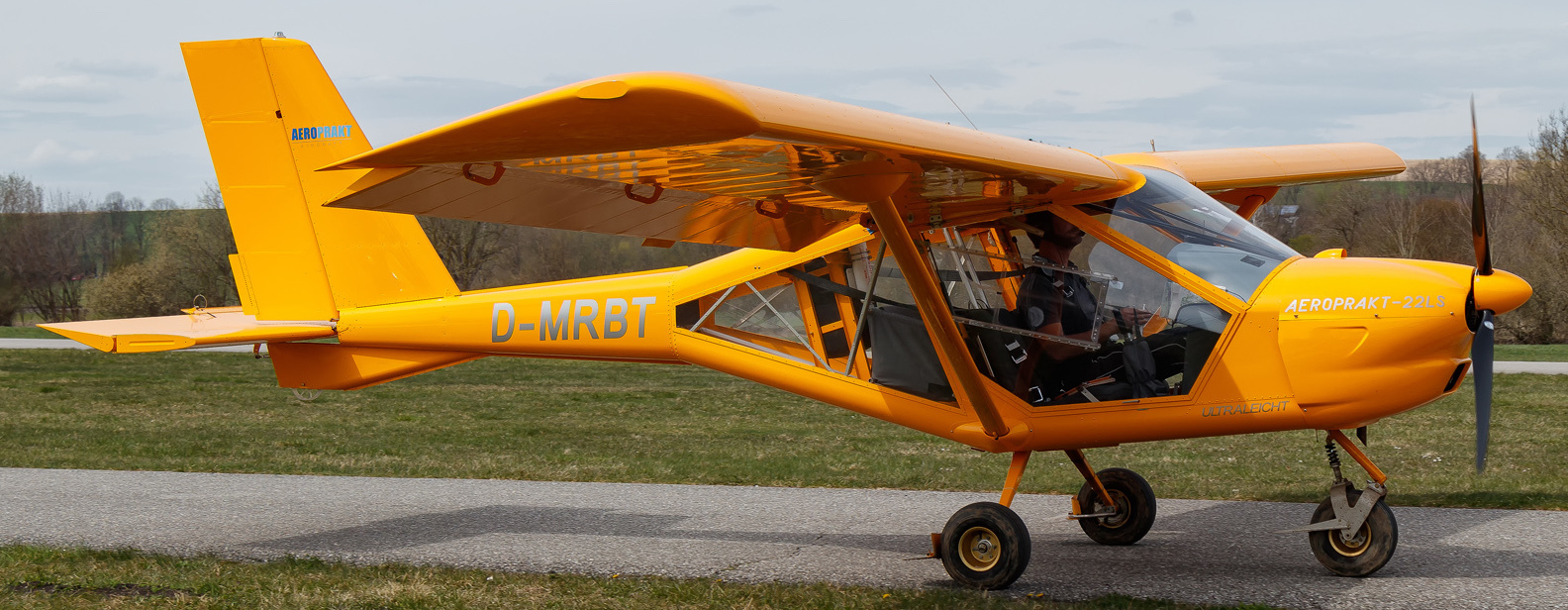
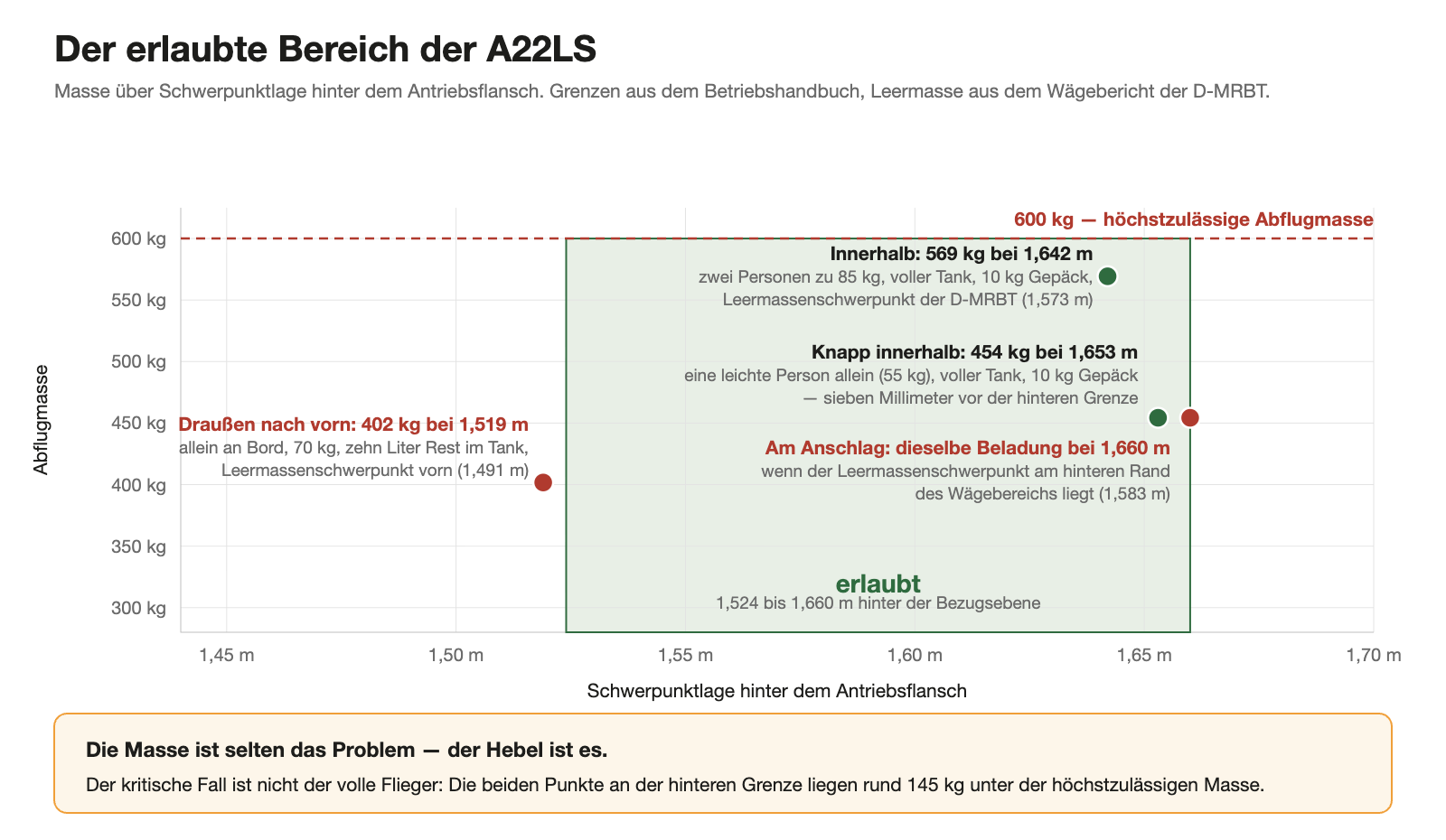
600 kilograms is one limit on the A22LS, and it is easy to keep. The second is less obvious: the centre of gravity must lie between 1.524 and 1.660 metres behind the engine flange — and you can fall out of this window well below the maximum mass.
As of: September 2026. All values come from section 6 of the A22LS operating manual with the standard 90-litre tanks. The empty mass and empty-mass CG in the example come from the D-MRBT weighing report of 22 March 2023: 324.5 kg at 1.573 m. Your manual and your valid weighing report are binding — the figures differ from aircraft to aircraft.
The datum is the engine flange
All lever arms are measured rearwards from there; the horizontal reference line is the fuselage centreline. Four numbers are enough for the calculation:
- Crew: 1.600 m
- Fuel: 2.000 m — one litre weighs 0.72 kg
- Baggage compartment: 2.300 m
- Empty mass and its CG: from the valid weighing report
The limits: maximum take-off and landing mass 600 kg, CG in flight between 1.524 and 1.660 m behind the datum, which corresponds to 23.3 to 33.5 per cent of the mean aerodynamic chord. A separate range applies to the empty aircraft: 1.491 to 1.583 m with the 90-litre tanks, 1.491 to 1.573 m with the optional 114-litre tanks. Then there are the payload limits: a maximum of 10 kg in the baggage compartment, 90 litres in the tank and at least 55 kg in the cabin.
The calculation in four lines
Each line is mass times lever arm. The sum of the moments divided by the sum of the masses gives the CG. Example for the D-MRBT with the values from its weighing report — 324.5 kg empty mass, empty-mass CG 1.573 m; your figures are in your own weighing report:
| Item | Mass | Lever arm | Moment |
|---|---|---|---|
| Empty mass per weighing report | 324.5 kg | 1.573 m | 510.4 kgm |
| Crew, two persons at 85 kg | 170.0 kg | 1.600 m | 272.0 kgm |
| Baggage, no more is allowed | 10.0 kg | 2.300 m | 23.0 kgm |
| Fuel, 90 litres | 64.8 kg | 2.000 m | 129.6 kgm |
| Total | 569.3 kg | — | 935.0 kgm |
935.0 divided by 569.3 gives 1.642 m. That is within the range, but only just under two centimetres ahead of the rear limit — with 30 kilograms to spare to the maximum mass.
You don't have to work this out by hand: the Weight and Balance calculator under Flight Planning does exactly these four lines — with the D-MRBT values and with the take-off distance as well.
Why mass is rarely the problem
Everything that is loaded sits behind the CG of the empty aircraft. Every person, every litre, every item of baggage therefore moves the CG rearwards. That is why what matters is not how much is on board but where.
The critical case is therefore not the full aircraft. A light person alone on board — 55 kg, the minimum payload —, a full tank and 10 kg in the baggage compartment give only 454.3 kilograms, but a CG at 1.653 m: seven millimetres ahead of the rear limit, with about 145 kilograms to spare to the maximum mass. If the empty-mass CG were at the rear edge of the permitted range — 1.583 m instead of 1.573 m —, the same load would come to 1.660 m and thus exactly at the limit. Two aircraft of the same type can come out differently with the same load; that is why your own weighing report cannot be replaced by a rule of thumb from the next airfield.
The forward limit catches those who fly light
The opposite case is easily overlooked. Alone on board, 70 kilograms, ten litres left in the tank, no baggage, and an empty-mass CG at the forward edge at 1.491 m: that gives 401.7 kilograms at 1.519 m — five millimetres ahead of the limit and therefore outside. With the D-MRBT's empty-mass CG (1.573 m) the same case comes to 1.585 m and stays inside. A solo training flight with an almost empty tank is therefore the case in which the forward limit comes within reach at all — and here too the weighing decides, not the loading.
What too far forward or aft means
A CG too far forward makes the aircraft heavy and nose-heavy: higher control forces, elevator effective later, longer landing. That is unpleasant but benign.
Too far aft is the other direction: longitudinal stability decreases, the aircraft becomes twitchy, reacts oversensitively to control inputs and is much less forgiving of a stall. That is why the rear limit is where it is — and why a full baggage compartment with a light crew is a worse idea than the scales would suggest.
The weighing report is the basis
It applies to this aircraft, in this equipment state. A new propeller, a newly installed device, a different seat — and it must be reweighed. The formula from the manual uses the weight on the three scales: nose wheel with the lever arm 0.532 m, main gear with 1.794 m.
What this means for a flying day
- Calculate before the flight, don't estimate — four lines take two minutes.
- Baggage is the strongest lever. 10 kg is the maximum, and 10 kg at 2.300 m weighs more in the moment than 10 kg on the seat.
- Fuel moves the CG aft. Full tanks are not automatically the safe condition.
- When flying solo with little fuel, think of the forward limit.
- Have the aircraft reweighed after every modification — otherwise the old report calculates with an aircraft that no longer exists.
Remember
600 kilograms is the limit on the scales. The limit that flies is 1.524 to 1.660 metres.